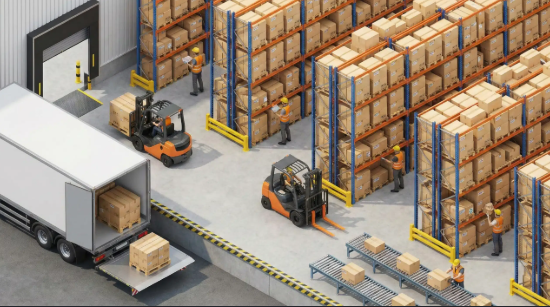
How the warehouse model is quietly reshaping renovation spending
Roughly half the money a homeowner spends on finishing materials can disappear into distribution. Not into the tile, the vanity, or the faucet itself, but into the chain of hands that moves those products from a factory in Spain or Italy to a showroom near you. Manufacturer, importer, regional distributor, retailer. Each link adds its margin. The buyer at the end pays for all of them.
That simple fact sits behind a shift that has been building across the renovation market for several years. Direct-from-warehouse selling, long common in groceries and electronics, has arrived in home finishing materials. And it is changing how people budget for kitchens, bathrooms, and floors.
The margin problem nobody talks about
Walk into a design boutique and price a vanity. Then price a comparable unit that came through fewer hands. The gap is often startling, and it rarely reflects a difference in the product. A vanity that leaves the factory at 200 dollars can reach a traditional retail shelf at 500 or more, not through greed but through arithmetic. Every intermediary carries overhead and needs profit to survive.
Shorten the chain and the math changes. By buying in volume and cutting out two or three layers, a business like the Entrepôt de la Réno warehouse can offer comparable products at prices that sometimes approach half of conventional retail. The pitch of cheaper yet equally durable rests on this structural difference, not on lower-grade materials.
See also: Smarter Home Entertainment Starts With the Perfect TV Setup
What buyers actually want now
Spending habits have shifted. After years when easy financing pushed turnkey projects, many homeowners have taken budget control back into their own hands. When comparing renovation materials, homeowners can also review practical guidance on choosing the right wood flooring to balance appearance, durability, maintenance, and long-term value. They compare prices online, they research specifications, and they will happily drive forty minutes to save a few hundred dollars on a flooring order.
This audience splits into three broad groups. The do-it-yourself homeowner who wants reliable material without paying the premium of white-glove service. The contractor buying across several job sites who watches every line item. And the property investor renovating to rent or resell, for whom the spread between material cost and added value determines the whole return.
All three share one demand: they want to see the product, know the real price with no surprises, and either leave with it or have it delivered quickly. The warehouse format answers those expectations well.
Specialization as an advantage
The big-box giants like Home Depot and Lowe’s built their success on staggering inventory and logistics. Competing on breadth of selection is a losing game. But a specialized warehouse does not need to sell everything. It picks its categories, usually ceramics, flooring, vanities, bathroom fixtures, and concentrates its buying power there.
That focus has a useful side effect. Staff actually know the products. Ask about the difference between a floating laminate and a rigid SPC floor and you get a precise answer rather than a shrug. That expertise, offered free, is worth real money to someone who has never installed a shower membrane before.
Multiple locations across a region also cut delivery times and freight costs. Heavy material like ceramic tile is expensive to ship. Having a pickup point nearby makes a genuine difference on the final invoice, something online-only sellers cannot always match.
Is equal quality at a lower price believable?
Skepticism is fair. A low price naturally raises suspicion of low quality. Yet in finishing materials, the link between price and durability is far weaker than most people assume.
Much of the ceramic tile sold in North America comes from the same factories, whether it reaches you through a small design shop or a warehouse. The price difference usually reflects branding, packaging, and distribution length, not the composition of the tile. The same logic applies to faucets and shower bases. What determines quality is measurable: a floor’s wear rating, a tile’s water absorption, a faucet’s cartridge type, a warranty’s terms.
That said, not everything is equal, and the warehouse model does not excuse skipping homework. A smart buyer still checks the wear class, the thickness of a wear layer, and the certifications on a heated floor system. The model simply lets you pay less for equal quality once you know what to look for.
The ripple effect across the sector
The arrival of this model puts healthy pressure on prices. Traditional retailers now have to justify their premium, usually through deeper service, elaborate showrooms, or exclusive brands. Some do it very well. Others lose customers who no longer see the added value.
For the consumer, that competition is good news. It widens choice and brings renovation within reach of budgets that, a decade ago, would have balked at the cost. A young couple buying a first condo to renovate can now redo a full bathroom for a fraction of what their parents would have paid.
The trust factor in a warehouse purchase
One question surfaces again and again when people first consider buying direct: can I trust a price this low? The instinct is understandable, but it points to the wrong worry. The thing to verify is not whether the price seems too good, but whether the specific product meets the specification you need.
Trust in this model comes from transparency, not from a fancy showroom. A warehouse that publishes clear product data, wear ratings, dimensions, materials, and warranties, gives you everything needed to judge quality on the merits. The absence of a marble-floored boutique does not make the tile behind it any different.
It also helps to buy from a seller with a physical presence you can visit. Being able to see the product, talk to knowledgeable staff, and confirm availability in person adds a layer of confidence that pure online sellers cannot match. The combination of warehouse pricing and a real location, staffed by people who know their categories, tends to earn trust quickly once a first purchase goes well. Many buyers arrive skeptical and leave as repeat customers, precisely because the promised quality showed up at the promised price.
What it means for your next project
Before launching a renovation, it pays to compare not just the sticker prices but the structure of the offer. A contractor’s quote that bundles materials often hides a comfortable markup on them. Supplying your own tile, vanity, or flooring by buying direct can trim the overall bill considerably.
The calculation does not always favor going it alone. Installing electric heated flooring under ceramic demands precision, and a mistake is costly to fix. But separating the purchase of materials from the labor remains a winning strategy for anyone who wants to keep control of the budget.
The renovation market keeps drifting toward more price transparency. Buyers are better informed, compare more, and reward the models that save them money without sacrificing durability. That underlying trend is still early, and it rewards first the people who take the time to understand where the price of the materials in their home really comes from.